
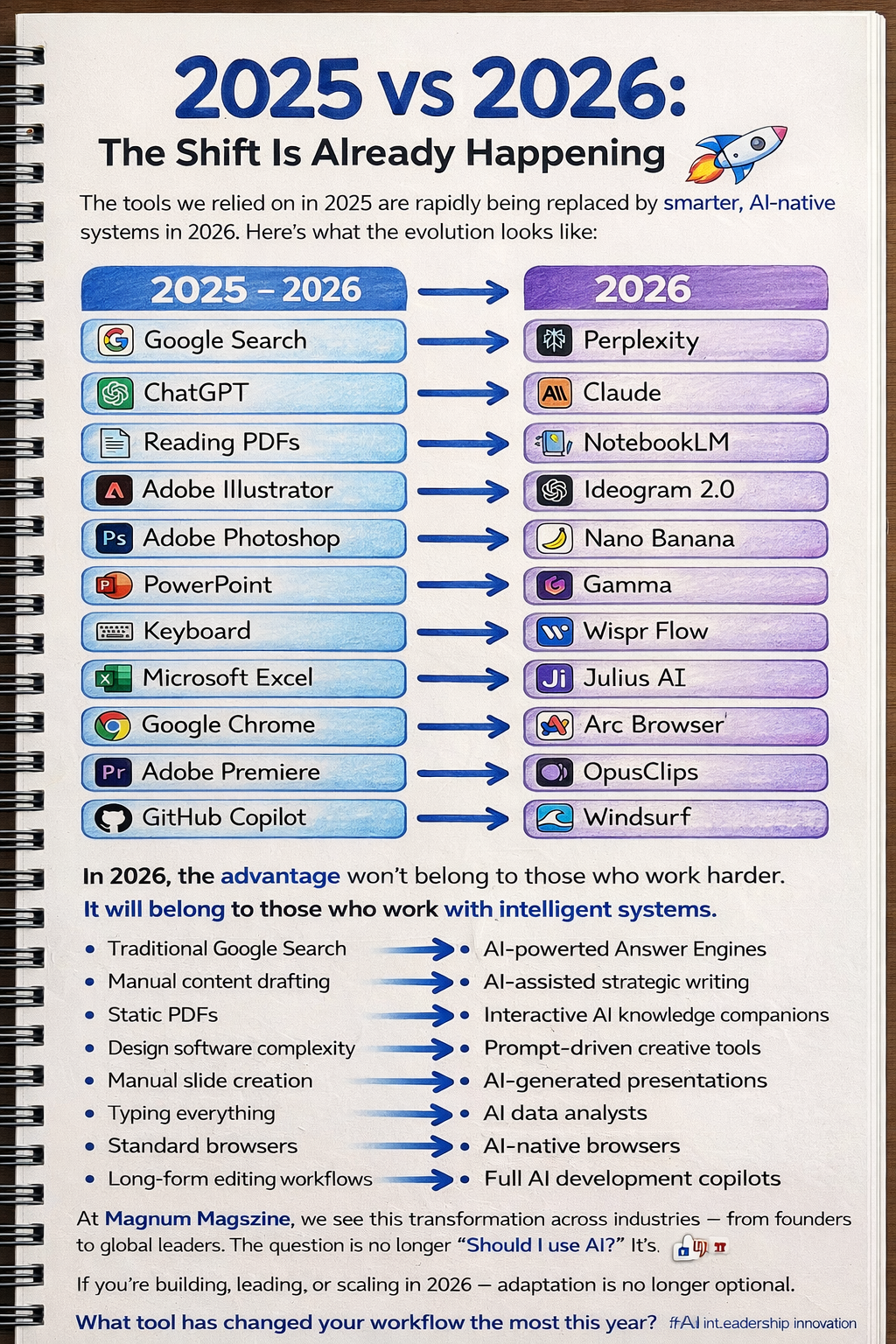
AI Tools 2026 Are Reshaping the Future of Work
AI Tools 2026 are no longer experimental enhancements — they are becoming operational infrastructure.
Between 2025 and 2026, organizations have moved from traditional digital tools to AI-native systems that compress execution time, automate reasoning, and enhance decision-making. For founders, executives, and growth-stage businesses, AI Tools 2026 represent a structural shift rather than a technological trend.
The competitive question is no longer whether to adopt AI.
It is how strategically AI Tools 2026 are embedded into your workflow architecture.
The Evolution: 2025 vs 2026
1. Search & Research
2025: Traditional search engines
2026: AI-powered answer engines
AI Tools 2026 eliminate fragmented browsing. Instead of navigating multiple links, leaders receive synthesized, contextualized insights instantly. This reduces research time and increases strategic clarity.
2. Content Creation & Communication
2025: Manual drafting
2026: AI-assisted strategic writing
AI Tools 2026 support structured long-form writing, tone calibration, brand alignment, and audience targeting. Executives can now produce thought leadership content with significantly reduced turnaround time.
3. Knowledge Management
2025: Static PDFs
2026: Interactive AI knowledge systems
AI Tools 2026 allow users to query documents dynamically, extract summaries, and request contextual analysis — turning static information into interactive intelligence.
4. Design & Creative Execution
2025: Skill-intensive design software
2026: Prompt-driven creative platforms
AI Tools 2026 shift creative power from technical mastery to conceptual clarity. Leaders articulate vision; AI executes visual production.
5. Presentations & Strategy
2025: Manual slide development
2026: AI-generated structured decks
AI Tools 2026 automate storytelling frameworks, visual formatting, and layout design, enabling faster investor presentations and board reports.
6. Data & Analytics
2025: Spreadsheet formulas
2026: AI-powered analytical assistants
AI Tools 2026 interpret datasets, detect patterns, generate insights, and recommend action points. Data analysis becomes decision-ready rather than manually processed.
7. Browsers & Workflow Integration
2025: Traditional browsers
2026: AI-native browsing systems
AI Tools 2026 integrate summarization, contextual recommendations, and workflow automation directly within browsing environments.
8. Video & Media
2025: Manual video editing
2026: AI-driven video clipping and repurposing
AI Tools 2026 identify key moments, generate captions, and optimize distribution formats automatically.
9. Software Development
2025: Code completion assistants
2026: Full AI development copilots
AI Tools 2026 assist in architecture planning, debugging, documentation, and feature development — significantly increasing development velocity.
Why AI Tools 2026 Matter for Leaders
AI Tools 2026 change the economics of scale.
Organizations integrating AI at the systems level are:
-
Reducing operational friction
-
Increasing creative throughput
-
Accelerating go-to-market cycles
-
Scaling output without proportional team expansion
The advantage in 2026 will belong to leaders who understand that AI Tools 2026 are not optional enhancements — they are strategic leverage mechanisms.
Strategic Implementation Framework
To operationalize AI Tools 2026 effectively:
-
Audit existing digital workflows
-
Identify redundant manual processes
-
Replace legacy tools with AI-native systems
-
Train teams in AI literacy and prompt structuring
-
Track measurable efficiency gains quarterly
AI adoption must move from experimentation to institutionalization.
The Leadership Perspective
At Magnum Magazine, we observe a consistent pattern among high-growth founders and global executives:
Those embedding AI Tools 2026 into their strategic core are outpacing competitors in speed, adaptability, and decision intelligence.
The future of work will not reward effort alone.
It will reward intelligent orchestration.
Final Analysis
AI Tools 2026 represent a transition from digital assistance to cognitive augmentation.
The critical question for organizations today is not:
“Should we adopt AI?”
It is:
“How deeply are AI Tools 2026 integrated into our operational architecture?”
The transformation is already underway.
Leaders who restructure now will define the next cycle of growth.









Leave A Comment