
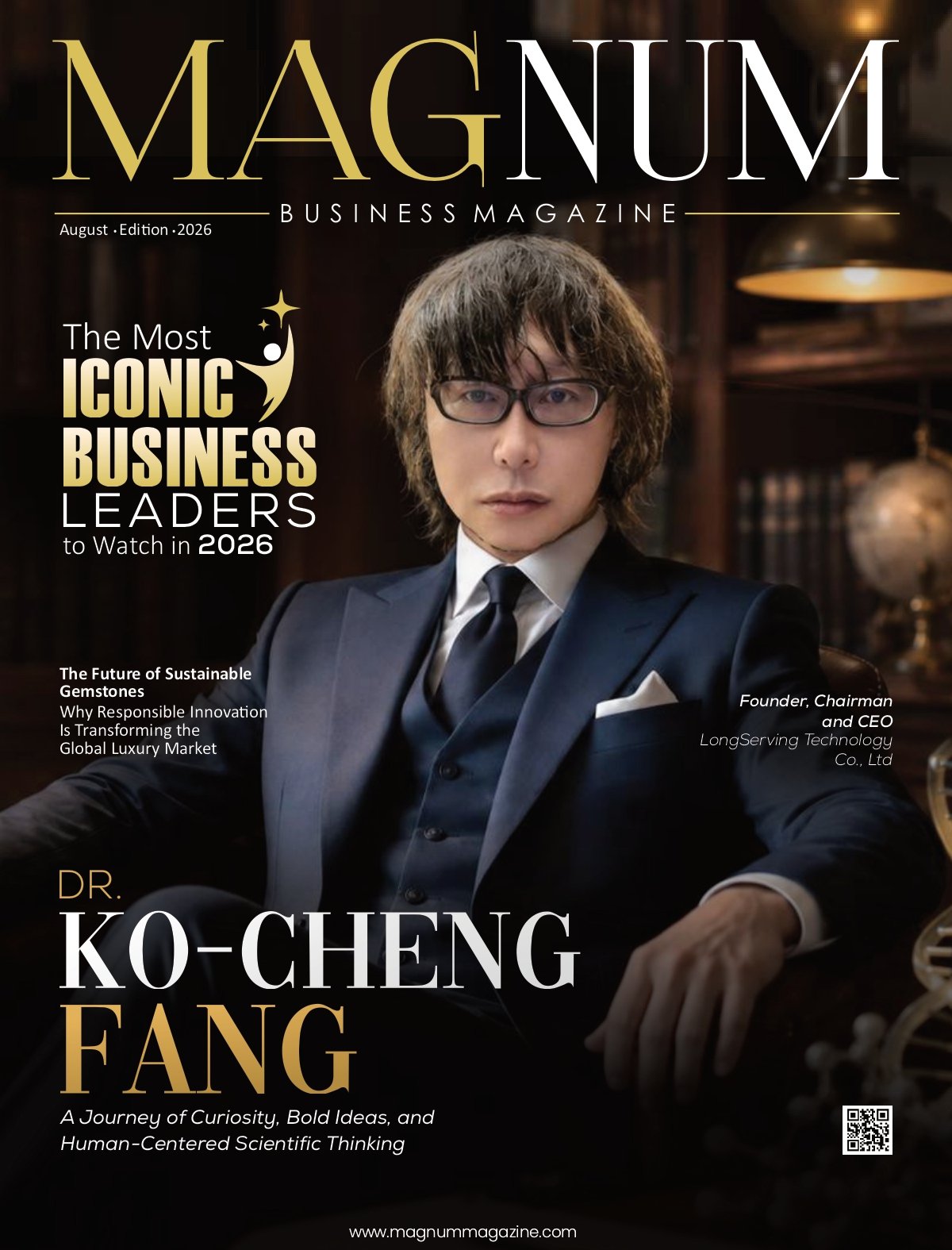
Dr. Ko-Cheng Fang: Innovation, Technology & Human-Centered Vision
Dr. Ko-Cheng Fang: A Journey of Curiosity, Bold Ideas, and Human-Centered Scientific Thinking
Great achievements are often the result of exceptional leadership. Certain individuals have distinguished themselves through their foresight, determination, and ability to inspire others. They have transformed challenges into opportunities and ideas into lasting outcomes. Their contributions have strengthened industries and driven positive change. More importantly, they have built legacies that continue to influence the future.
Among such leaders is Dr. Ko-Cheng Fang, a leader whose commitment to innovation and excellence inspires growth. He is an accomplished professional who has set a standard for success. His journey stands as a reminder that lasting impact is built through resilience, integrity, and a clear sense of purpose.
Defying Limits
Innovation has always been fueled by the courage to challenge accepted limits. Throughout his career, Dr. Ko-Cheng Fang has embraced a simple philosophy: many things considered impossible are simply problems awaiting solutions.
Whether in photonic quantum materials, laboratory-grown Imperial Green jadeite, biotechnology, or advanced cybersecurity, he has never been driven by existing trends.
“I have never focused on following existing trends. Instead, I focus on identifying future possibilities and building the technologies needed to realize them.”
Instead, Dr. Fang concentrates on uncovering future opportunities and creating the technologies required to bring them to life. When others expressed doubt, he viewed it as encouragement rather than resistance. He believes true breakthroughs demand patience, perseverance, and a willingness to pursue overlooked paths.
To him, progress is achieved not by accepting boundaries but by constantly pushing beyond them.
The Broader Perspective
Over the course of his career, Dr. Ko-Cheng Fang‘s thinking has shifted from mastering individual specialties to appreciating the connections that unite them. He began his journey in areas such as cybersecurity and software systems, but gradually came to realize that the principles behind innovation and problem-solving often transcend industries.
This understanding inspired him to explore diverse fields, including advanced materials, biotechnology, photonic computing, and fine art. Rather than seeing them as separate worlds, he views them as complementary sources of insight capable of sparking new ideas.
One lesson has remained especially meaningful to him: remarkable discoveries often emerge where disciplines overlap. Many of his breakthroughs have come from applying knowledge gained in one area to challenges in another. This broader perspective has allowed him to uncover opportunities that conventional approaches might miss.
For him, creativity thrives on curiosity and continuous learning. He believes that the more we look beyond familiar boundaries, the more possibilities we are able to uncover.
Enduring Commitment
One of the most important lessons Dr. Ko-Cheng Fang has learned is that vision means little without the commitment to follow through. While ideas are easy to imagine, turning them into reality requires patience, discipline, and sustained effort.
Over the years, his work as an inventor, entrepreneur, and researcher has taught him that meaningful results rarely come quickly. Whether in photonic computing, advanced materials, biotechnology, or other areas, progress has always been shaped by learning, experimentation, and continual improvement.
“I have also learned that setbacks are not signs of failure. They are part of the innovation process and often provide the insights needed for future success.”
Every challenge presents an opportunity to refine both the technology and the approach behind it.
To him, bringing ideas to life takes more than creativity. It requires resilience, adaptability, and the determination to keep going, even when the destination is not yet clear. After all, lasting achievements are built through consistent effort and belief in a greater purpose.
Strategic Curiosity
In an increasingly complex world, Dr. Ko-Cheng Fang believes the most important question is not how a problem can be solved, but whether it is important enough to be solved at all.
He directs his time and efforts toward challenges that can generate lasting value, benefit society, and contribute to a better future for humanity.
“When evaluating opportunities, I look for problems that are fundamental rather than temporary. I ask whether solving them could unlock new possibilities, advance scientific understanding, or significantly improve people’s lives.”
When assessing opportunities, he focuses on issues that are fundamental rather than short-lived. He considers whether addressing them could create new opportunities, deepen scientific knowledge, or meaningfully improve people’s lives.
This philosophy has shaped his work in photonic computing, advanced materials, biotechnology, cybersecurity, and other emerging fields.
He is also attracted to areas where traditional approaches have reached their limits. History has repeatedly demonstrated that significant breakthroughs often emerge when established ideas are questioned, and alternative directions are explored.
At the same time, curiosity remains a key influence on his decisions. He closely follows developments across diverse disciplines, recognizing that some of the most promising opportunities arise where different fields converge.
He dedicates his intellectual and creative efforts to areas that bring together scientific importance, practical value, and the ability to influence the future. In his view, these are the challenges most deserving of pursuit.
Reasoned Vision
Dr. Ko-Cheng Fang believes that the best decisions come from balancing logic with intuition.
When faced with important choices, he first looks at the facts. He evaluates technical feasibility, weighs potential risks, and considers the long-term impact of a decision. This helps him stay grounded and make choices based on a clear understanding of reality.
At the same time, he trusts the value of intuition. Through meditation and reflection, he creates space to think beyond immediate data and recognize patterns that may not be obvious at first. Years of experience have strengthened this instinct, helping him sense which opportunities may hold the greatest promise.
Intuition is never accepted blindly. It often points him toward a direction, but rigorous analysis is used to test and validate that insight. When both logic and intuition align, he moves forward with confidence. When they do not, he takes a closer look until he gains greater clarity.
Ultimately, he sees logic, intuition, and reflection as complementary forces. Together, they help him navigate complexity, adapt to uncertainty, and make thoughtful decisions in a rapidly changing world.
Thoughtful Focus
In an era defined by constant change and an endless flow of information, Dr. Ko-Cheng Fang believes that clear thinking begins with simplicity and focus.
One of his key practices is being selective about the information he consumes. Rather than responding to every development, he concentrates on insights that are relevant to long-term objectives and meaningful outcomes.
He also places great importance on creating time for deep thought. By setting aside uninterrupted periods for reading, reflection, and organizing ideas, he can step back from daily noise and focus on larger strategic priorities.
Another important habit is continuous learning. He actively follows advancements across a wide range of industries and technologies, allowing him to connect broader trends and understand where the future may be heading rather than focusing on individual events.
“I also regularly step away from daily work to review direction and priorities, ensuring that decisions remain aligned with long-term vision rather than short-term pressure.”
Equally important, Dr. Fang regularly pauses to reassess his direction and priorities. This helps ensure that his decisions remain guided by long-term vision rather than immediate pressures.
Together, these habits enable him to maintain clarity, stay focused on what matters most, and make thoughtful decisions even in a rapidly evolving world.
Foundations of Photonics
A major shift in Dr. Ko-Cheng Fang‘s career came at a point when he started to seriously question the limits of traditional electronic computing.
Back then, most progress in the field was happening in small, incremental steps built around semiconductor-based systems. However, he began to wonder whether computation had to remain tied to electrons at all, or whether an entirely different physical medium could open up a new level of performance.
That curiosity eventually led him into photonics, where light is used instead of electrons to carry and process information.
On the materials side, he developed the idea of “X-Photon,” moving it from a conceptual thought into something more practical that could support advanced photonic signal generation and transmission.
By challenging the long-held belief that electronic circuits were the only foundation for computing, he began to rethink computation from the ground up, not just as a hardware improvement but as a fundamentally different system.
“Rather than optimizing existing systems, I began focusing on building a new architecture based on photonic interactions, X-Photon materials, and advanced materials science.”
That shift in thinking changed the direction of his work. Rather than trying to improve existing architectures, he focused on building a new approach based on photonic interactions, X-Photon materials, and advances in material science.
Over time, this led to work on next-generation photonic systems designed to push beyond the physical limits of conventional electronics.
Explore LongServing’s photonic and optical quantum chip work.
Dr. Fang often sees this phase as a reminder that real progress rarely comes from accepting established answers as final. It tends to begin when those assumptions are quietly questioned, opening space for entirely new ways of thinking.
Tech Convergence
Dr. Ko-Cheng Fang believes that one of the most overlooked realities of today’s technological landscape is how quickly different fields are starting to merge.
He often points out that innovation is still widely viewed through old boundaries, where areas like artificial intelligence, computing, materials science, and biotechnology are treated as separate worlds.
In practice, these lines are fading fast. Each field is beginning to shape the others, and the most meaningful breakthroughs are increasingly coming from this overlap rather than from isolated progress within a single domain.
He also highlights a quieter but important shift in how progress itself unfolds. Instead of gradual, predictable improvement, more and more change is happening in sudden leaps.
In computing, for example, many still expect traditional electronic chips to remain at the center. Yet emerging ideas like photonic computing suggest that the entire structure of computation could eventually look very different.
“Many critical breakthroughs depend not just on optimizing existing technologies, but on the emergence of new materials that set entirely new limits for what is possible.”
He also feels that materials science does not always get the attention it deserves. In many cases, real breakthroughs are not just about improving existing systems, but about discovering new materials that completely change what is technically possible.
Another point Dr. Fang emphasizes is the accelerating pace of change. The time it takes for an idea to move from research labs into real-world use is shrinking quickly. Without adjusting our sense of timing, it becomes easy to underestimate how fast disruption is actually unfolding.
For him, the real story is not any single technology taking the lead, but the way multiple fields are advancing together, interacting more deeply, and creating a compounding wave of change across the system as a whole.
The Tech Fusion
Dr. Ko-Cheng Fang believes one of the most overlooked shifts today is how quickly different technologies are starting to blend into one another.
He often notes that innovation is still seen through old boundaries, where AI, computing, materials science, and biotechnology are treated as separate lanes.
In reality, those lines are fading fast. These fields now overlap and reinforce each other, and the most meaningful breakthroughs, in his view, are coming from this interconnected system rather than isolated progress in any one area.
He also sees a clear break from steady, linear improvement toward sudden jumps in capability. In computing, many still expect silicon chips to remain the foundation. Yet emerging ideas like photonic computing hint at a very different future, where the structure of computation itself is redesigned.
“The transition from laboratory research to real-world application is becoming significantly faster, and using outdated time expectations can easily lead to misjudging the scale of disruption.”
He further emphasizes that materials science is often underappreciated. Some of the biggest leaps, he believes, don’t come from refining what already exists, but from discovering new materials that shift what is physically possible.
Another change he highlights is speed. The path from research to real-world use is getting shorter, and outdated timelines often fail to capture how fast disruption is actually happening.
For him, the real story isn’t any single technology, but the way multiple fields are evolving together, creating a compounding shift that reshapes the system as a whole.
Open Exploration
Dr. Ko-Cheng Fang often says his curiosity is sustained by a simple feeling that we are still very early in understanding what is truly possible.
Even after years spent working across photonic computing, advanced materials, and biotechnology, he notices a consistent pattern: every new answer seems to open up several new questions.
Rather than feeling settled by this, he finds it energizing. For him, the unknown is not a gap to be filled quickly, but something that naturally keeps the work alive.
He is particularly drawn to the spaces where disciplines overlap. In his experience, the most interesting ideas rarely sit neatly inside one field. They tend to appear in the gaps where concepts from one area haven’t yet been fully carried into another.
It is often in those in-between spaces that new perspectives quietly take shape.
To stay open to that kind of thinking, he tries not to lean too heavily on familiar methods or past success. He keeps engaging with new research, unfamiliar viewpoints, and emerging technologies, while also making space to step back and reflect.
For him, curiosity isn’t something that fades with experience. It depends more on how willing you are to keep questioning what you already know.
As long as he continues to look beyond established limits, that sense of exploration stays very much alive.
Resilient Creation
Some of the most defining experiences in Dr. Fang‘s career have come from taking on work that sits far outside easy answers, including photonic chip technology and laboratory-grown Imperial Green jadeite.
Both areas demand operating at the edge of current science, where progress is slow, uncertain, and often shaped by repeated failure before any real breakthrough appears.
In photonic systems, he has often had to push against the limits of what is currently understood in physics and engineering. The work calls for patience, careful attention to detail, and the willingness to rethink entire approaches when new constraints surface.
In a similar way, developing lab-grown jadeite has required him to study how nature forms it over time and then recreate those conditions in a controlled environment, which has involved continuous experimentation and refinement.
Over time, these challenges have deeply influenced his outlook. They have strengthened his patience and discipline, and reinforced the idea that real innovation rarely moves in a straight line.
More often than not, staying with a problem through uncertainty matters more than achieving quick results.
“I have learned that meaningful innovation is rarely linear, and that persistence through uncertainty is often more important than immediate success.”
He carries this mindset into how he guides teams. Dr. Fang values long-term commitment over immediate wins and encourages people to see difficulty as part of the process rather than something to avoid.
For him, meaningful breakthroughs are built through steady effort and persistence, not through shortcuts around complexity.
Principled Leadership Matters
As technology becomes more deeply embedded across industries, Dr. Ko-Cheng Fang believes that the qualities that matter most in leadership are still the ones that cannot be automated.
Judgment Rooted in Values
While machines can analyze vast amounts of data, he feels only humans can truly decide what is right, meaningful, and aligned with long-term human progress.
In uncertain situations, this sense of direction becomes especially important.
Empathy
For Dr. Fang, understanding people’s concerns, motivations, and hopes is something no system can fully replace.
Leadership, in his view, is ultimately about people, and that depends on trust and genuine human understanding.
Imagination
He often emphasizes that the biggest leaps in history didn’t come from data alone, but from people who were able to picture something that didn’t exist yet.
That ability to imagine new possibilities still stands as a uniquely human strength.
Even as technology accelerates, he believes these human qualities ensure progress doesn’t become purely mechanical. Instead, they help shape advancement that is not only faster but also more thoughtful, responsible, and meaningful.
Inner Clarity
Over the course of his professional journey, Dr. Ko-Cheng Fang has come to understand himself with far greater clarity and depth.
At the beginning of his career, his focus was almost entirely on outcomes and technical execution. Progress was something he measured through results, innovation, and tangible output, and he rarely paused to question how his decisions were formed or what internal reasoning shaped his direction.
With time and experience, he began to realize that leadership extends beyond achievement alone. It is equally shaped by the way one thinks, reflects, and understands oneself.
This awareness did not emerge suddenly, but through lived exposure to complex work, uncertain conditions, and the steady accumulation of lessons from both success and failure.
“As my self-awareness improved, my leadership and decision-making also changed. I became more intentional in how I make decisions and more open to considering different perspectives more comprehensively.”
As this self-awareness strengthened, his approach to leadership naturally evolved.
Dr. Fang’s decisions became more intentional, and he grew more comfortable slowing down to examine situations from multiple viewpoints before settling on a direction.
Alongside this shift, his attention to quality and refinement also deepened. In bringing any product or idea to completion, he now focuses closely on even the smallest details, ensuring that every component is carefully shaped and aligned as closely as possible with its intended standard.
A Purposeful Journey
If his life is ever looked at in hindsight, Dr. Ko-Cheng Fang does not hope it is summarized by positions held or milestones reached.
Those, in his view, are only surface markers. What matters more is the way he chose to think, act, and carry himself through the journey.
He would prefer to be remembered as someone who did not let curiosity fade with certainty.
Even when answers were unclear or inconvenient, he kept returning to questions others might have walked past. For him, curiosity was never just a trait; it was the entry point into anything worth understanding.
There is also the matter of persistence. Much of the work he has been involved in does not move in straight lines. It stretches time, tests patience, and often offers very little clarity in the middle.
He stayed with those processes anyway, not because it was easy, but because he believed that anything meaningful takes time to unfold properly.
“I hope my life shows that it is possible to care about both innovation and humanity at the same time.”
He also places a quiet importance on how people treat ideas and each other. He sees progress as something that rarely happens alone. It depends on exchange, on disagreement handled with respect, and on the willingness to listen without immediately closing doors.
Above all, he hopes his path suggests a simple balance: that building new things and staying human are not competing goals.
Technology, for him, only has real value when it remains connected to the people it is meant to serve.
Driven by Curiosity
If future generations ever look back on Dr. Ko-Cheng Fang‘s life, he hopes they will remember far more than the titles he held or the milestones he achieved.
What matters most to him is the way he chose to live and the values that shaped his decisions along the way.
He hopes to be seen as someone who never lost his sense of curiosity, even when the answers were unclear, and who was willing to ask questions that others might have overlooked.
To Dr. Fang, curiosity has always been the spark behind discovery and one of the driving forces behind meaningful progress.
He also hopes people will recognize his belief in perseverance. The things that truly matter are rarely simple or immediate. They require patience, resilience, and the willingness to keep moving forward, even when the path ahead is uncertain.
Throughout his journey, he has tried to trust the process rather than chase quick wins or easy answers.
At the same time, he has always valued people and the exchange of ideas. He believes that the greatest advances in human civilization are made when individuals listen to one another, work together, and remain open to viewpoints different from their own.
“I hope my life shows that it is possible to care about both innovation and humanity at the same time.”
More than anything, he hopes his life reflects the idea that innovation and humanity should go hand in hand.
While creating new technologies is important, he believes their true value lies in how they improve lives and serve people with purpose, responsibility, and compassion.
In the end, that balance is the legacy he hopes to leave behind.
Explore Dr. Ko-Cheng Fang’s Work
Readers interested in learning more about Dr. Ko-Cheng Fang and his work can explore the official resources associated with LongServing Technology.
- Official Website:
LongServing Technology
- Founder Profile:
Dr. Ko-Cheng Fang – Founder Profile
- Photonic Technology:
Optical Quantum Chips
- Biotechnology Research:
LongServing Biotechnology Research
- Instagram:
@ko_cheng_fang_david
Discover More Stories on Magnum Magazine
Magnum Magazine brings readers closer to influential entrepreneurs, innovators, leaders, educators, and changemakers shaping the future across industries.
Explore All Articles
Explore Latest Magazine Issues
Read More Cover Stories
About Magnum Magazine
Contact Magnum Magazine
Follow Dr. Ko-Cheng Fang
Follow Dr. Ko-Cheng Fang and discover updates surrounding his work in technology, innovation, science, and interdisciplinary research.
Instagram:
@ko_cheng_fang_david