
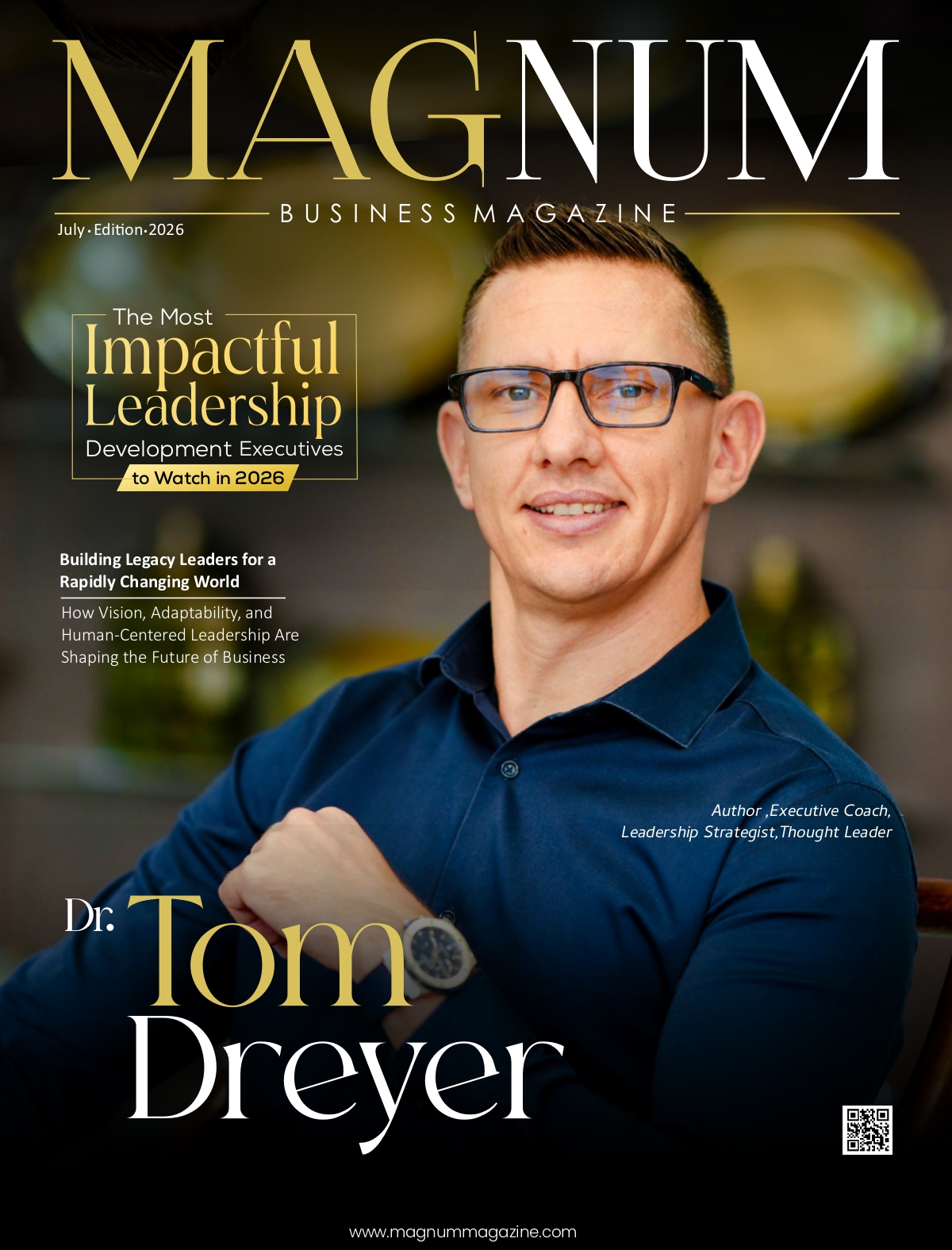
Inside the Mind of a Leadership Architect
Inside the Mind of a Leadership Architect
In an age where leadership is often measured by titles, influence, visibility and performance metrics, Dr. Tom Dreyer’s story begins somewhere far more human.
It begins in South Africa, with a young boy learning responsibility before he was ready for it. At 14, while most teenagers were still discovering who they were, Tom was already navigating the realities of independence, work, uncertainty and survival. Those early years were not easy, but they shaped something that would later become central to his life’s work: the belief that leadership is not about power. It is about purpose, resilience and service.
Long before he became a leadership development executive, ICF-accredited coach, author, speaker and architect of national leadership programmes, Tom learned that people often carry far more potential than they can see in themselves. His earliest experiences of tutoring, mentoring and helping others understand difficult concepts planted the seed for a career dedicated to human transformation.
“I learned early that the greatest leadership gift you can give someone is helping them see their own potential,” he reflects.
That belief has followed him across three countries, multiple industries and more than two decades of leadership and talent development work. From South Africa to the United Arab Emirates and now Saudi Arabia, Tom has built a career around one clear mission: helping leaders lead with purpose, learn with passion and shape a legacy that outlives them.
The Journey Behind the Philosophy
Tom’s career did not begin in a corporate boardroom or executive education programme. It began in operational environments, where discipline, safety, systems and human behaviour were part of everyday life. His early work in South Africa’s energy and industrial sectors gave him a grounded understanding of how organisations really function.
This practical foundation became important later. It meant that when he moved into learning and development, he was not designing programmes from theory alone. He understood the pressure of operations, the complexity of people, and the gap that often exists between strategy and execution.
Over time, he discovered that his real passion was not simply training people to perform tasks. It was helping people grow into the leaders they were capable of becoming. That curiosity eventually led him into deeper academic study, culminating in a PhD in Learning and Development. His research explored the interpersonal competencies that leaders, mentors and coaches need to create sustainable impact, bringing together neuroscience, psychology, coaching, adult learning and practical leadership application.
The question that continued to shape his work was simple but powerful: why do some leaders unlock potential in others, while others unintentionally limit it?
This question became the foundation of his leadership philosophy.
Leadership as a Living Culture
Throughout his career, Tom has challenged the idea that leadership development should be treated as a once-off event. For him, real transformation happens when leadership becomes part of the culture of an organisation.
This belief was tested and strengthened during his decade in the United Arab Emirates, where he played a significant role in shaping leadership and talent development across ADNOC’s complex ecosystem. There, he established and lead the Talent Development Centre of Excellence across 15 companies, designing leadership, executive development, succession and coaching strategies at enterprise scale.
One of the most significant examples of this work was the Leading for Legacy programme, which reached more than 3,200 leaders and delivered a 53% uplift in leadership capability. The programme was recognised with the CIPD Middle East Award, validating the idea that leadership development can be both deeply human and measurably impactful.
Another defining achievement was the creation of an internal coaching ecosystem that certified more than 200 ICF coaches and generated $3.15 million in savings. Beyond the financial impact, it proved something more enduring: organisations become stronger when they build capability from within rather than depend indefinitely on external expertise.
For Tom, this was never just about efficiency. It was about sustainability.
“The strongest leadership systems do not import capability forever,” he says. “They cultivate it from within.”
That principle continues to shape his work today.
From Organisational Impact to National Leadership
Tom’s current role as Leadership Development Director at His Royal Highness Crown Prince Mohammed bin Salman Foundation (Misk) has expanded his work from organisational transformation to national leadership development. At Misk, his mandate is connected to one of the most ambitious transformation agendas in the world: Saudi Arabia’s Vision 2030.
His work supports the development of leaders across multiple levels, from high-potential youth and emerging leaders to senior executives and national leadership communities. Through flagship initiatives such as 2030 Leaders, 10X Leaders, Misk Fellowship, Ignited Voices, Distinct and the Saudi Leadership Society, Tom contributes to a leadership pipeline designed to prepare Saudis to lead across government, private and non-profit sectors.
What makes this work particularly meaningful is its combination of global perspective and local relevance. Tom has worked with leading institutions and partners such as Harvard, Oxford, London Business School, Esade, Franklin Covey and many more, but his focus is not on importing generic global models. It is on adapting world-class practices to the cultural, strategic and national context in which leaders operate.
This is where his work becomes especially distinctive. He is not simply delivering leadership programmes. He is helping build leadership ecosystems that are relevant, scalable and sustainable.
At the heart of this work is the belief that leadership development should strengthen not only individual leaders, but also institutions, communities and nations.
The Book That Became a System
Tom’s book, 10 Golden Stars to Leadership Excellence, captures much of the thinking that has shaped his career. Written after more than two decades of leadership experience, academic research and coaching practice, the book offers a practical framework helping leaders overcome the most common challenges they face.
The book covers themes such as self-awareness, leadership style, team dynamics, trust, high-performance teams, emotional intelligence, communication, resilience, digital-age leadership and talent development. It combines neuroscience, practical tools, reflective exercises and real-world stories, making it less of a theoretical leadership text and more of a hands-on companion for growth.
Its central message is that leadership excellence is not a destination. It is a journey.
The book has been endorsed by respected voices in leadership and human capital, including Scott Jeffrey Miller, who described it as “the perfect balance of theory and practice” and a resource for leaders from the frontline to the C-suite.
Yet the real significance of the book lies in what it became after publication. Tom transformed the 10 Golden Stars framework into a broader Leadership Excellence ecosystem, including a self-paced digital journey, a 12-module online masterclass delivered over three months, interactive face-to-face workshops and modular leadership development experiences that can be embedded into wider organisational and national programmes. The Leaders Excellence masterclass has also been endorsed and recommended by Marshall Goldsmith, widely recognised as the world’s #1 thought leader most respected executive coaches globally.
This reflects one of Tom’s strongest abilities: turning insight into application, and application into scalable systems.
The book is not designed to sit on a shelf. It is designed to be lived, practised, reflected on and applied.
Coaching with Evidence, Challenge and Humanity
While Tom’s work has reached thousands through programmes and platforms, much of his deepest impact still happens in coaching conversations.
With more than 2,800 coaching hours and experience across energy, education, entertainment, construction, retail, hospitality, banking, aviation and non-profit sectors, he has coached leaders across a wide range of levels and contexts, from high-potential talent to CEOs, senior executives and national leaders.
His coaching approach is evidence-based, neuroscience-informed and practical, yet at its core, it is deeply human, grounded in empathy, self-awareness, and a genuine commitment to unlocking individual potential and lasting transformation. He uses psychometrics, reflection, behavioural insight and structured coaching tools to help leaders understand the patterns behind their decisions, communication, confidence and impact. At the same time, his style is known for being warm, direct and often “spiced with a pinch of humour.”
Tom does not see coaching as advice-giving. He sees it as a developmental partnership that helps leaders sharpen awareness, challenge assumptions and make better choices under pressure which reinforced one of his long-held beliefs: leadership is tested most clearly when complexity, pressure and people dynamics collide.
Building Bridges Across the Human Capital Ecosystem
Beyond his executive roles, Tom has also expanded his work through Leadership Blueprints and the Human Capital Bridge, two platforms that reflect his broader vision for making high-quality human capital support more accessible.
Leadership Blueprints houses his leadership development frameworks, masterclasses, workshops and digital learning journeys. It is designed to make leadership development practical, flexible and scalable, especially for organisations seeking structured growth without losing the human dimension.
The Human Capital Bridge responds to another challenge Tom has observed throughout his career: many organisations need support in the human capital space, but struggle to identify credible, quality-assured partners who understand their context.
Through HCB, Tom connects organisations with a curated network of more than 115 vetted partners across leadership development, coaching, learning, assessment, consulting and organisational transformation. The model offers zero-cost matchmaking, preferential rates, quality assurance and the ability to bring together multiple partners when complex solutions are needed.
What makes HCB especially meaningful is its humanitarian model. One percent of every project’s value is directed towards social impact initiatives within the client’s region. For Tom, this is not an add-on. It is a reflection of his belief that business and humanity should grow together.
Science and Soul
One of the reasons Tom’s work resonates across cultures is that it bridges what are often treated as separate worlds: science and soul, data and story, performance and humanity.
He is deeply interested in neuroscience, behavioural science, AI, learning analytics and digital transformation. He believes the future of leadership development will be increasingly personalised, adaptive and data informed. AI and analytics will make it possible to identify development needs more precisely, measure behavioural change more effectively and provide leaders with tailored learning pathways.
But Tom is equally clear that technology is not transformation.
AI can analyse patterns, but it cannot replace purpose. Digital platforms can scale access, but they cannot replace trust. Data can reveal gaps, but leaders still need courage to change behaviour.
This balanced view has shaped his approach to modern leadership development. He believes the future belongs to organisations that can measure impact intelligently while still honouring the human realities of leadership: fear, ambition, uncertainty, trust, belonging, resilience and meaning.
For him, leadership development must be rigorous enough to produce measurable outcomes and human enough to change lives.
The Personal Grounding Behind the Professional Mission
Despite the scale of his work, Tom remains grounded by the people closest to him.
He often describes family as his greatest classroom in patience, empathy and joy. In a career filled with executive responsibilities, national programmes, coaching engagements and international partnerships, his personal life keeps his philosophy anchored in something real.
For Tom, leadership is not something that happens only in boardrooms or workshops. It is a way of being. It is found in how one listens, how one responds under pressure, how one shows up for family, how one treats people who cannot offer anything in return, and how one uses influence to create opportunity for others.
This is why his message to leaders is not simply about achieving more. It is about becoming more.
The Legacy Question
In many ways, Tom’s journey reflects the evolution of modern leadership itself.
The future no longer belongs to leaders who rely only on authority, hierarchy or technical expertise. It belongs to those who can build trust, navigate complexity, communicate with empathy, adapt quickly, make ethical decisions and create environments where people can perform sustainably.
This is the kind of leadership Tom continues to champion through his coaching, writing, programmes and partnerships.
His awards, including the CIPD Middle East Award, PRISM Award, Vice Chancellor’s Award for Neuroscience Contribution in Leadership and International Golden Quill Award, validate the quality and impact of his work. His publications and book add intellectual substance. His executive roles demonstrate scale. His coaching gives the work intimacy and depth. His platforms extend the impact beyond individual organisations.
But the real measure of his legacy is not in awards or titles.
It is in the leaders who begin to see themselves differently. The organisations that become more humane. The teams that learn to trust. The young professionals who discover confidence. The executives who reconnect with purpose. The systems that continue to develop people long after a programme ends.
From a young boy in South Africa learning resilience through necessity, to a leadership architect shaping human capital systems across the Middle East, Dr. Tom Dreyer’s journey is a story of survival transformed into service.
And perhaps that is why his work feels so relevant now.
In a world moving faster than ever, where leaders are overwhelmed by complexity, technology and pressure, Tom offers a reminder that feels both timely and timeless: leadership is not ultimately measured by how much authority one holds, but by how many people one helps to rise.
Continue the Leadership Journey
For those inspired by Dr. Tom Dreyer’s story and philosophy, his work extends beyond the pages of this feature. Leaders, executives, and organisations who wish to explore one-on-one leadership coaching can contact him directly at leadership@drtomdreyer.com.
Readers who want to engage with his thinking more deeply can access his book, 10 Golden Stars to Leadership Excellence, at https://drtomdreyer.com/books/. The book brings together neuroscience, practical leadership tools, reflective exercises, and real-world stories to help leaders turn common challenges into opportunities for growth.
For a more immersive development experience, the Leadership Excellence Masterclass is available at https://drtomdreyer.com/courses/10-golden-stars-to-leadership-excellence/. The journey includes video lessons, practical toolkits, animations, audiobook segments, reflection activities, and applied leadership practices designed to help leaders lead with purpose, learn with passion, and shape a lasting legacy.
Readers are also welcome to connect with Dr. Tom Dreyer on LinkedIn at https://www.linkedin.com/in/drtom-dreyer/ to learn more about his leadership work, coaching, programmes, and broader human capital initiatives.
Leadership Philosophy in Five Words
Purpose. Awareness. Trust. Courage. Legacy.